What is a personal execution system?
A repeatable structure that turns what you know and what you want into scheduled actions — and then checks whether they happened.
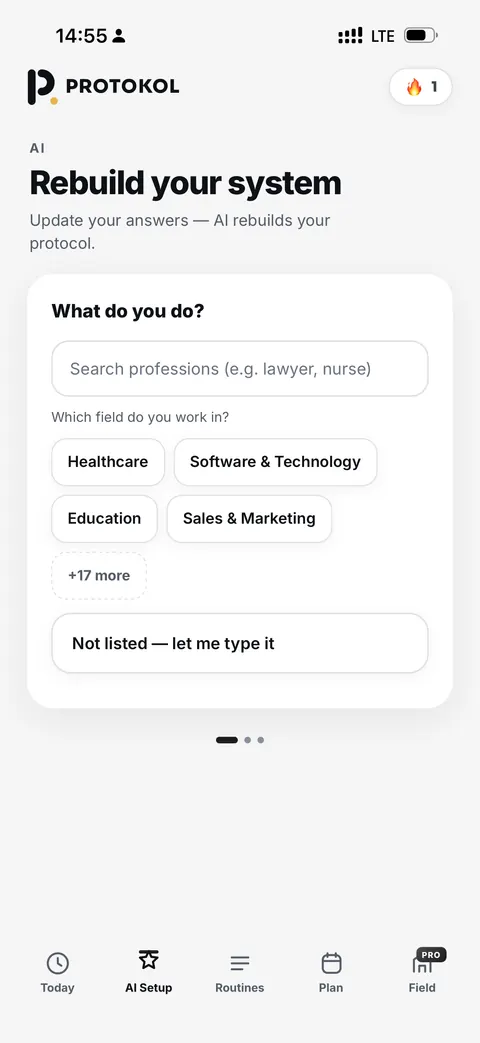
Input → adaptation → schedule → review.
Every system that reliably turns intention into behaviour has the same skeleton, whether it is run on paper or in software:
1 · Input
Something worth acting on: a book, a goal, an idea, a skill you want. Without a real input, a system only shuffles chores.
2 · Adaptation
The translation step almost everyone skips: what does this principle mean for my job, my week, my level? Generic advice dies here.
3 · Schedule
An action without a time is an opinion. The system puts each action at an hour, next to the routines that already structure your day.
4 · Review
A record of what actually happened — not to feel guilty, but to see which actions survive contact with a real week and which need shrinking.
PROTOKOL implements the four parts directly: books and goals are the input, AI rewrites principles for your profession (121 professions across 21 fields), the Today tab holds the schedule, and History with the PDF report closes the review loop. The how-it-works page shows each step on the real screens.
Execution systems, briefly
What is a personal execution system?
A personal execution system is a repeatable structure that turns what you know and what you want into scheduled actions, and then tracks whether they happened. It has four parts: an input (knowledge, goals), an adaptation step (what does this mean for me?), a schedule (when exactly?) and a review (did it happen?).
How is that different from a productivity app?
A productivity app stores tasks you already thought of. An execution system decides what is worth doing — from your own inputs — and holds you to it. The difference is who does the thinking.
Is PROTOKOL a personal execution system?
Yes — that is the product. Books and goals are the input, AI adapts them to your profession, the Today tab is the schedule, and History, reports and the coach close the review loop.
Run the system instead of building one.
Setup is three questions. The first plan is ready the same minute.